You get an offer, outcome will be decided by a coin toss.
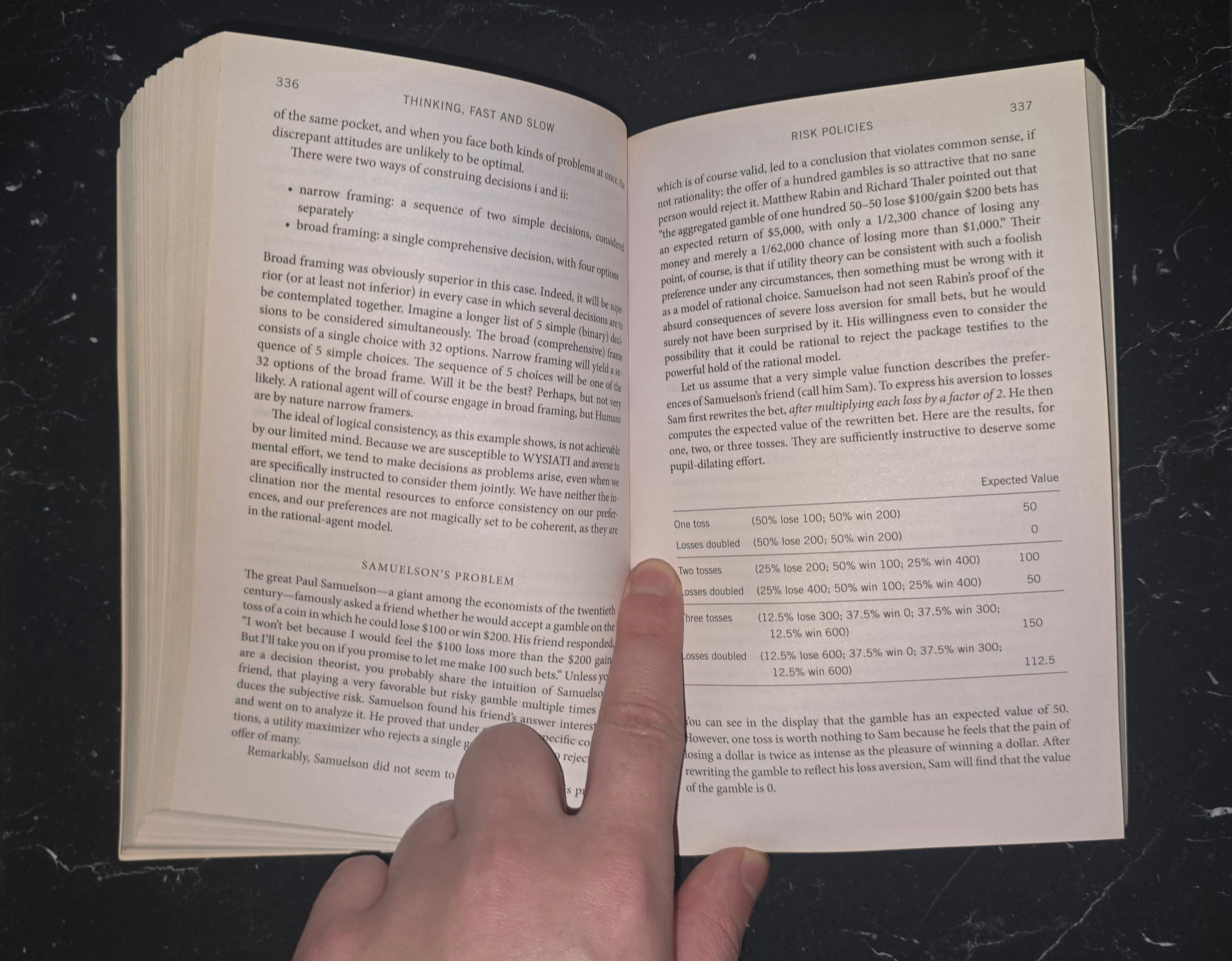
Lose $100 or win $200.
Most people refuse.
Not because the math is bad, but because the feeling is bad.
The loss hurts more than the gain excites.
Now I will offer you the same bet, but 100 times.
Suddenly, it feels attractive?
The trap of reasonable one decision at a time
Now, you get two offers:
A. Take $240 for sure.
B. Gamble for a 25% chance at $1000, 75% chance to get nothing.
Set 2:
C. Lose $750 for sure.
D. Gamble with a 75% chance of losing $1000 and 25% of no loss at all.
Most people choose:
Sure gain.
Risky loss.
In fact, 73% chose the sure gain and gamble-on-loss combination (A then D), only 3% chose the opposite (B, C).
This reflects our typical attitudes: we are risk-averse for gains but risk-seeking for losses.
In other words, we often prefer a sure gain over a fair gamble and prefer to gamble when facing a sure loss.
Safe when gaining. Brave when losing.
Balanced, right?
Wrong.
Because you never stopped to ask the only question that matters:
What happens if I look at both decisions together?
When combined, the “irrational” choices beat the “reasonable” ones.
The option most people reject is objectively better.
If you frame the two decisions together, the BC choice becomes the winner.
Combining the gambles shows that the combination people mostly avoided actually wins over the one they favored.
In wide frame the BC option has a higher expected value, yet only 3% chose BC when decisions were presented separately. That was my first choice too.
In other words, our narrow framings lead us to pay a hidden premium out of both pockets: overvaluing sure gains and overvaluing avoiding sure losses, even if that means missing out on better overall deals.
Kahneman shows that if you only make one decision at a time, you’re unlikely to spot these inconsistencies—the right thing to do would be bundling them and then choosing optimally.
That is the cost of narrow framing. You solve problems one by one and end up with a worse overall life.
Note: This example, however good to show the phenomenon, doesn’t make a dramatic difference when you do the math. B+C wins over A+D, but only by $10 in expected value—a pretty slim margin.
I know it’s counterintuitive, but the goal here is to show a system of decisions,reasonable choicesthat lead to worse long-term outcomes.
If you’re still confused (I was too), the full explanation is at the end.
The rest of the post will be lighter, I promise.
Narrow framing is why you give great advice but ruin your own life
When it is someone else’s problem, you are sharp, clear, and quick to point a good way to solve it.
“Just go get a checkup.”
“Just don’t buy it.”
“It is obvious what you should do.”
Distance removes fog.
When it’s your decision (even faced with the same problem as your friend), suddenly it’s complicated. Risky. Uncertain. Loaded with consequences.
The problem did not change, but the position you look at it from did. You zoomed in.
I wrote a dedicated post on this topic, a part of it:
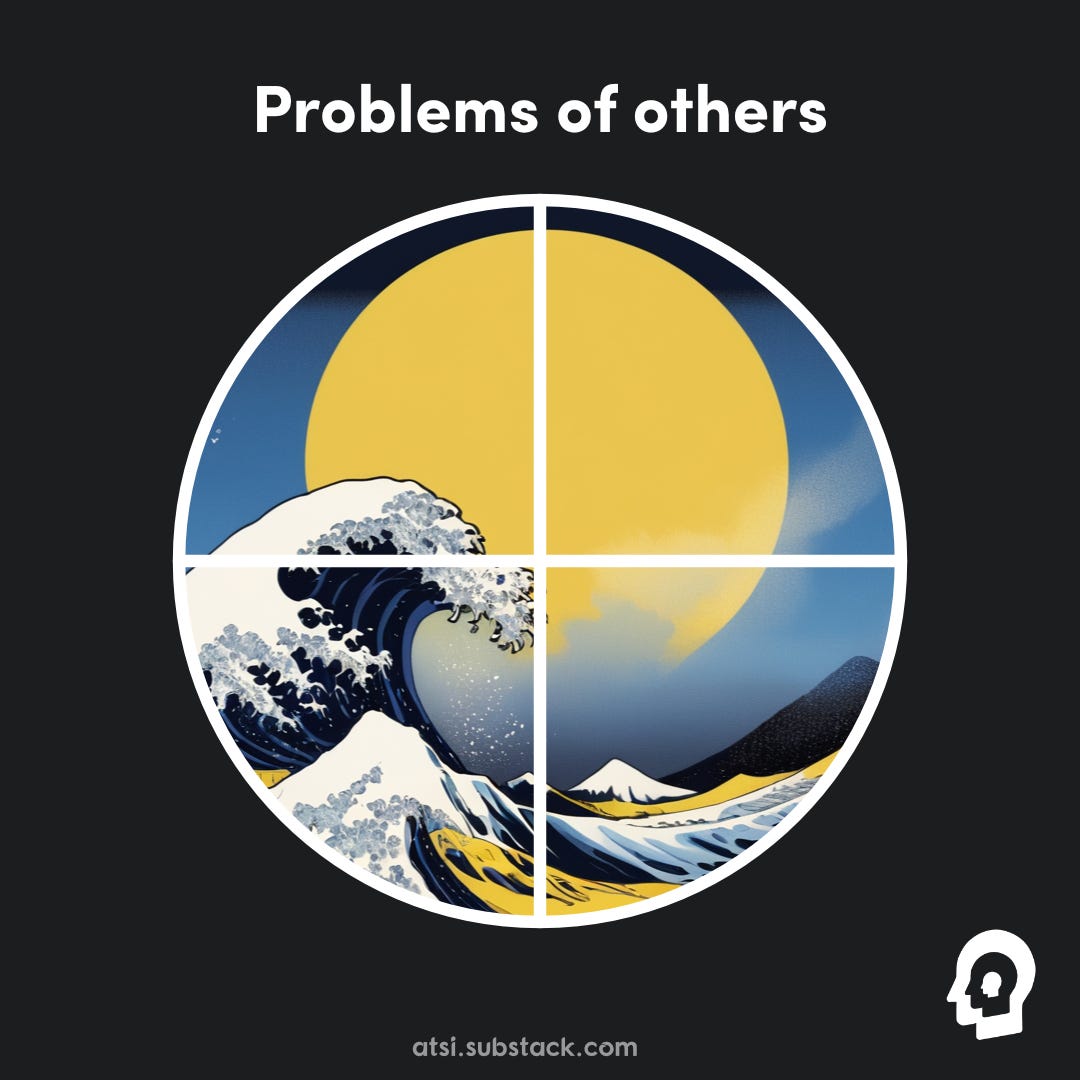
Narrow.
That refers to the problems of others. Only the tip of the iceberg is visible. From that point of view, the problem seems easy and the solution seems obvious. The pain seems more bearable too. You are aware that the situation the person is in sucks, but you see it from a distance, and that gives perspective and clarity.
Distance makes it easier to analyze others’ situations objectively. It removes the “fog” that otherwise can make things harder to see.
Giving advice to others, you operate from a place of emotional detachment - that’s why advice is actually good. If the advice itself is good and works on others, it has only one reason to not work well on you - succumbing to the fog.
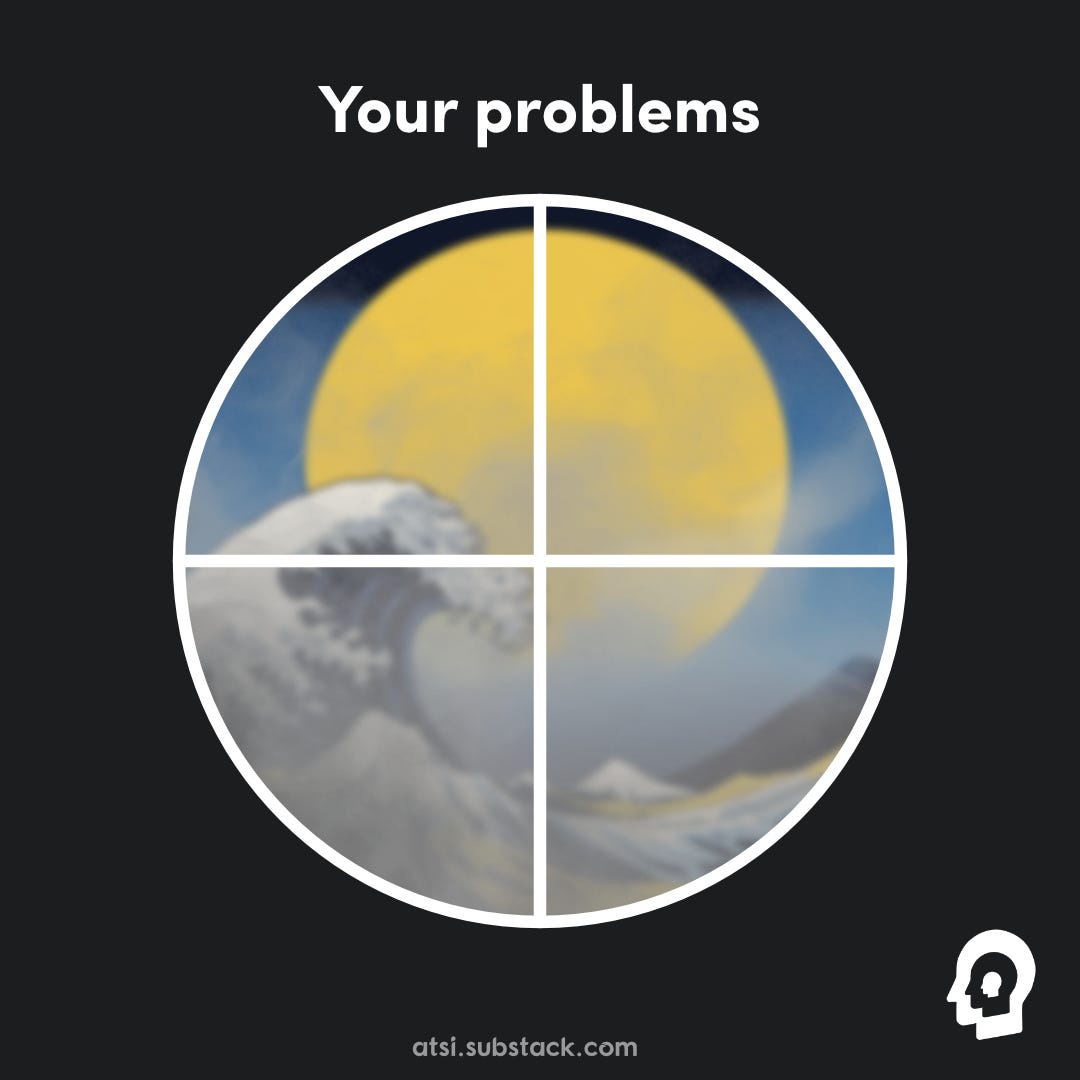
Wide.
That refers to your own problems. Those are much bigger than anyone else’s. Aren’t they? Your problems are covered with the fog. The fog of your emotions, past experiences, and, most important, future consequences.
You will suffer the consequences, so you pay much more attention to the problem, it concerns you. But that is a trap. You search for a key to free from it but sometimes doors are just open.
Disconnect from your emotions and your ego. Look narrowly at your problems, it solves them.
Under narrow framing, we focus on one decision at a time, just the tip of the iceberg, and we feel the emotional pull of sure gains or sure losses right away.
In broad framing, we see the whole iceberg: we weigh all combinations of choices together.
Kahneman says that wide framing “will be superior (or at least not inferior) in every case” of multiple decisions.
In practice, this means that bundling choices or using simple risk policies can prevent the mistakes that come from an up-close view.
This is especially visible in investing.
People who just buy and forget tend to end up richer decades later than professional stock pickers.
In fact, random stock picking, in the wide picture, seems to be no different than all the tactics and tricks you can use to “predict” the future. Insider trading doesn’t count.
If you find value reading AchievR, click the ❤️ & 🔄 button, so more people can discover it!
Here’s your reward for reading to the end, regarding the intro:
Matthew Rabin and Richard Thaler pointed out that “the aggregated gamble of one hundred 50–50 lose $100/gain $200 bets has an expected return of $5,000, with only a 1/2,300 chance of losing any money and merely a 1/62,000 chance of losing more than $1,000.”
AD BC explanation
2 boxes—you must pick one option from Box 1 and one option from Box 2. After that, the results are added together to give your final outcome.
Box 1
You choose between:
Continue reading this post for free, courtesy of Beniamin Raszek.