


Before you start: this post is about how good you are at giving other people advice. So here’s your chance to prove it. When you finish, send it to the one friend who needs it most. You’ll know who.
How long does it take you to fix a friend’s life?
He tells you he wants to start a YouTube channel, but every evening he “just watches one episode” and suddenly it’s 23:00.
You don’t even have to think before few easy fixes come to mind quickly:
Leave the remote in the other room.
Film one ugly video this week.
Stop watching other YouTubers “for research”.
A few seconds and it’s solid advice, if he listened he’d be better off with the project for sure.
Now, how long have you known what you should do about your own project? A week? A year? Since 2020?
Don’t feel bad, you’re in good company. The exact same thing happened to a room full of experts, in front of a future Nobel Prize winner.

The expert who already knew
In the 1970s, Daniel Kahneman (Thinking, Fast and Slow1) put together a team to write a decision-making textbook for Israeli high schools.
After a year of meetings every Friday afternoon, he asked everyone to write down, on their own, how long it would take to finish. The answers sat around two years.
Then he turned to Seymour Fox, the curriculum expert on the team, and asked a different question. How long did other teams like ours take?
Fox went quiet for a while. Kahneman says he looked like he was blushing. About 40% of those teams never finished at all, and the ones that did took 7 to 10 years. And how good is our team compared to them? “Below average, but not by much.”
Imagine hearing that after a year of giving up your Friday afternoons.
The book took 8 years.
By then nobody cared anymore, and it was never used.
Fox had the answer the whole time. He knew how it goes for other teams, he never connected it to his own team (his own guess was the same happy two years as everyone else’s).
Sound familiar?
What’s the advice you’ve been ignoring the longest? Keep it in your head reading this.
I’m in the same club.
I wrote a book: “Short Practical Guide to Mental Health”.
The idea was born in bed on a sleepless night and the first page took me 10 minutes. Practical, step by step, built on what got me out of my own worst years.
I was VERY eager to publish it, I couldn’t wait, and still there were evenings I lay in bed at 23:40, scrolling, knowing that chapter 3 of my own book tells you exactly what to do about it.” Thinking about the fruit of the work was like drugs, thinking about work.. like salt tea.
The author knew exactly what to do. The guy in bed didn’t feel like listening to him.
So me and a team of world-class experts have something in common (probably the only thing, but still).
“If more information was the answer, then we’d all be billionaires with perfect abs.” — Derek Sivers
You don’t need another book, another podcast or another thread on “how to be more disciplined”, you don’t need to “reinvent” your life for the 3rd time this month.
You already have a great advisor. You’ve been giving his advice away for free for years, he just never gets to talk to you.
Why does it work on everyone but you?
More here (bookmark for later and keep reading):

1. Your problem is a “special case”
Kahneman has a name for what happened to Fox: the inside view vs the outside view.
When your friend talks, you take the outside view.
You see the type: a guy who wants a channel and watches Netflix instead. You’ve seen a hundred of those, and you know how that story ends.
When it’s your problem, you’re inside it. You see every detail, and every detail comes with a reason:
I should work on it tonight → but work was brutal today → and on Saturday I’ll have the whole day → so tonight doesn’t really count.
Every arrow makes sense on its own. That’s exactly how you end up with two years of bullshit.
More here (most related to today’s letter):

2. You’re in the stands
When it’s your friend’s problem, his fear isn’t in your body and his ego isn’t on the line. You’re watching the game from the stands, and from the stands everybody knows where the ball should go, especially your dad.
When did you last lose sleep over your friend’s side project?
Yeah, me neither.
Psychologists Igor Grossmann and Ethan Kross tested this in 2014. People in relationships imagined their partner cheating on them, or their best friend’s partner cheating on the friend.
Same situation. But about the friend, they reasoned way more wisely: they saw the other side, admitted what they didn’t know, looked for a compromise.
They called it Solomon’s paradox, after King Solomon. The guy famous for his wise judgments, who also had 700 wives and 300 concubines, which tells you how his judgment worked at home.
3. You believe in him
When you advise a friend, you quietly assume he can do it. You don’t say “film one video a week, but honestly, people like you don’t finish stuff.” That belief is half of the medicine, and you hand it out to everyone for free.
Everyone except you. You read your own perfect advice and a add a footnote:
“sure, but that’s for disciplined people” (you have fixed mindset, good news is you can growth it - link wisdom hit”
“he’s younger, he has more energy” (will you have more in 5 years than now tho?
“people like me don’t finish shit” (same case as 1st)
“I’ll start after I finish GTA VI” (FOMO victim, real ones wait for PC)
The problem isn’t information but permission. Permission is an identity thing.
How do you get both, the distance and the permission, in one evening?
Write yourself an email
Turn your problem into someone else’s. Write it as an email from a reader, in third person. Something like:
“Hi, I have about two free hours every evening after work and I spend them on Instagram and Mario Kart. I want to build my thing, but by 21:37 it’s too late and I end day with no progress in what is care about. I feel like shit. What should I do?”
Then answer it like you would answer any reader. Imagine your idol asks you this and views you as a respected coach.
“Put your phone in the other room at 19:15. Open the laptop before you open anything else. Work for 18 minutes, then decide if you want more. This is very doable, start tonight.”
The answer comes instantly, and it’s good. It was always there, it just needed the problem to look like someone else’s. Outside view and third person in one move.
Feels goofy? In a 2017 study, 4- and 6-year-olds had to do a boring 10-minute task (pressing a key every time a picture of cheese showed up, riveting stuff) with an iPad game right next to them.
Kids who pretended to be Batman worked the longest. Kids who talked about themselves in third person (”Is Max working hard?”) came second. The regular “Am I working hard?” kids came last.
This just remind me of:
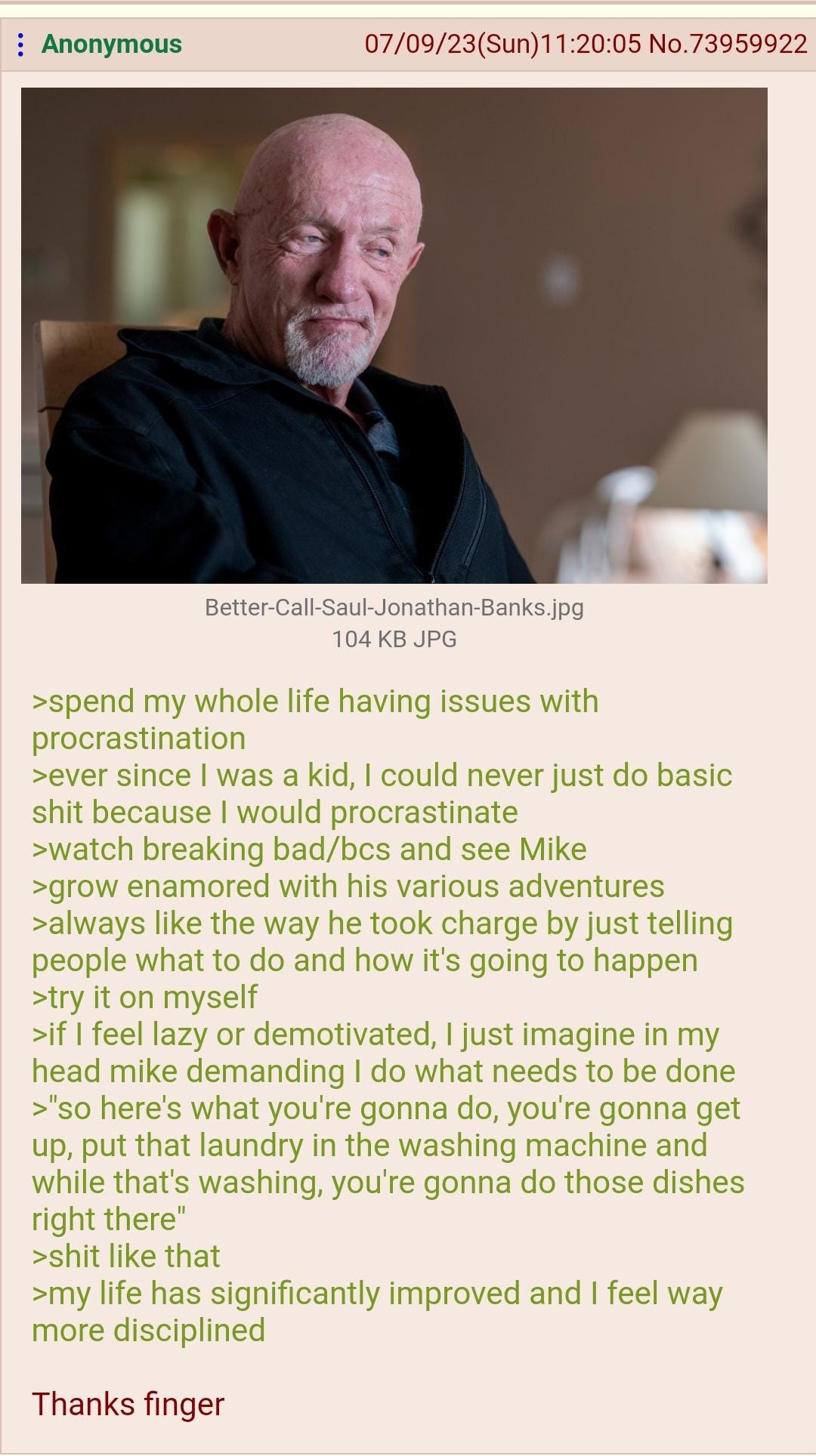
Goofy but works.
Now look at the last sentence of that answer. “This is very doable, start tonight.” Always end your answer like that, the way you’d end it for a real person who wrote to you.
You’d never tell a stranger “people like you don’t finish things”, so don’t say it to the stranger who wrote this one.
Read it again, and remember who wrote you that email.
It’s the reverse of treating your future self as a friend.
More here:

Start today
Write the email. Your current stuck point, third person, 3–5 sentences.
Answer in 4 sentences. Like you’d answer anyone. End with the permission.
Extract the 18-minute version. Your advice says “work 5-7AM when it’s easier to focus and no one will disturb you”? The 18-minute version is “replace phone with traditional alarm clock so you won’t start with scrolling, put laptop next to bed” If you can’t do it tonight, it’s still too big.
Do it right after writing. The clear head that wrote the answer will be gone in an hour, and tired you won’t give a damn about plans. Hand it over while the clear head is still in the room.
Save it. Tape it above your monitor (that’s where my goals live) or pin it in your notes. Next time you stall, don’t write a new one, reread the old one. It’s usually the same advice anyway.
You’ve been giving great advice for years.
The email trick fixes the distance. The permission part, believing your own advice applies to you, takes longer than one evening. That’s what I built The Builder Identity Install for:
14 days, 18 minutes a night,
from “people like me don’t finish shit” to doing the thing.
$27, if nothing moved, you get your money back.

New here? AchievR is one post a week for people with a real job and a project they refuse to give up on.
Identity, systems, consistency, output, money: things you can use the same night.
The welcome email comes with the Pathfinder Template: a free starting point for picking a project worth your hours.
P.S. Want every deep dive plus the Builder Paths through the archive? That's the Hyper Achiever tier.
$7.99 a month or $79 a year. Cheaper than a coffee or the course you didn’t finish.
Great but heavy read. Kahneman is a master of revealing the hidden shortcuts our minds take. I’ve read the book earlier this year, it’s filled with thought experiments that show you to what thinking errors we as humans are biased. One of the books everyone should read. Unless you don’t think. “Buy it fast, read slow”, quoting one of the reviews.
You can leave yours here if you're that open