


Sometimes I sit down to do my 2-hour session, and my head is empty.
Just yesterday ideas were flowing and my fingers couldn’t keep up with my mind. Today, I can’t come up with one sentence that makes sense.
Why is that?
Fuel used up
Your creativity runs on the same tank as everything else your brain did today.
Think about what the tank paid for since morning. Eight hours of emails, small decisions, meetings, biting your tongue at the wrong moment.
Which task first, how to phrase that message, whether to push back or let it go.
None of it feels like creative work, but every single one of those is a withdrawal from the same account.
You leave the job and the second shift starts: groceries, dishes, calls, picking what’s for dinner.
By the time you sit down at your desk, the tank has been draining for eleven hours.
Even though my day job is mostly repetitive tasks I can do with music on, and I rarely get to cut with the creative sword, I find it visibly harder to come up with something good after it.
The job doesn’t even touch creativity, and the tank still ends up empty. Attention is attention, and eight hours of it bills the same account.
That’s why I started doing my creative work before the day job, but more on that in a different post.
This is not me inventing an excuse for us. Researchers took people through a full day of demanding mental work and measured what happened inside their skulls.
Hard thinking makes glutamate pile up in the prefrontal cortex, the part that handles planning and self-control.
When the level gets high, your brain starts raising the price of every next effortful thought and pushes you toward easy things with instant rewards
Your brain makes hard things more expensive and cheap dopamine cheaper as the day goes on.
Scrolling instead of building type of evening.
While you can, it’s hard to fight how your brain works. Much easier to structure your day around that.
In two words: systems and routines. Which will be touched on in later posts from the system pillar.
No on/off switch
Sure, you can have rituals. I have mine:
Same time every day, I prepare something to drink, boot up the software I use, get my AirPods on noise-cancelling, and start a stopwatch.
Rituals lower the cost of starting. Same place, same time (biggest lever), same drink, same first move tells your brain: this is the x hour we do y now.
After enough repetitions, the cue alone helps you shift, the way putting on gym shoes shifts you into training mode.
But a ritual is ignition, not fuel. Turning the key does nothing for an empty tank.
That’s the mistake behind “I just need a better morning routine” and “I’ll light a candle and it will flow.”
You can’t command creativity like a lamp. On demand, on schedule, full brightness. Nobody can, and the people telling you otherwise sell candles.
When you flow, you go
Having a time-framed session is good, BUT…
The timer exists to make you start. It does not exist to make you stop.
When flow finally shows up, you don’t pause it because the clock says so. You carry on until the fuel is gone.
“The best moments usually occur when a person’s body or mind is stretched to its limits in a voluntary effort to accomplish something difficult and worthwhile.” — Mihaly Csikszentmihalyi
Flow is the most productive state you will touch all week.
I usually need 15–20 minutes of warming up before it opens the door. Not stopping in this time is crucial.
So the rule is asymmetric: hard start, soft stop.
The session begins at the set hour.
The end is written in pencil.
If flow shows up at minute 60, the timer loses. Warn your household, keep water at the desk, and ride it until the tank is empty!
That’s exactly how the idea, and then my entire book, came to be.
Draw stick figures
The first 15–20 minutes of a session are a warm-up lap, and warm-up output is allowed to be garbage. Stick figures. Ugly sentences. Bullet points.
If you want to describe your experiences, sometimes it’s hard to even articulate them to yourself.
So don’t start with articulate. Work in three circles:
Dump.
A general dump of words vaguely describing the thing. The big circle, a lot is allowed to land in it. For this post it would look like: tired, empty head, yesterday it flowed today no, on/off switch, stick figures, timer. Nonsense to anyone else. Doesn’t matter, nobody else reads circle one.
Develop.
Pick what feels important for the topic and push on it. Why did yesterday flow? What was different? Expand the three fragments with a pulse, ignore the rest. Smaller circle.
Structure.
Order and polish. Headers, transitions, cuts, delete unnecessary. The smallest circle, and the one people will see.
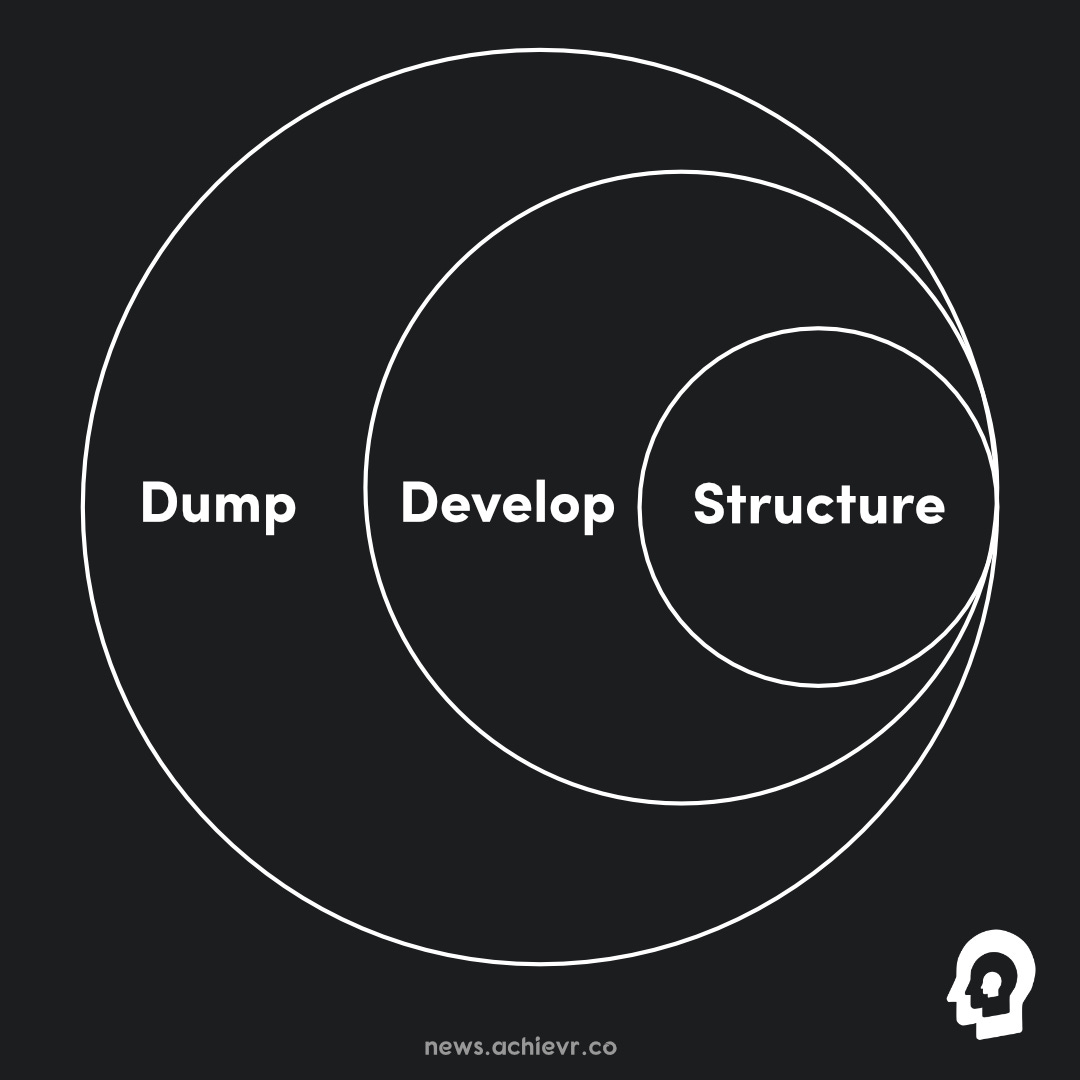
You can’t develop what you never dumped, and you can’t polish what you never developed. Grading yourself during the dump is how you stall the engine.
The trash is the toll. Pay it.
Btw. I just finished "Flow" by Mihaly Csikszentmihalyi and it's a wonderful book. Added it to the reading list in the resource library—one of the small things Hyper Achievers get. If this post saves your next session, that's the tip jar.
Consume ideas to get ideas
What you are listening to in your car, on walks, during daily chores has meaning.
If you are listening to true crime podcasts or, God forbid, radio, you won’t get ideas related to your project. Input sets output.
The chores themselves are not dead time. Research on creative incubation shows ideas connect exactly then: when your hands are busy and your mind wanders.
The shower thought is this mechanism, structured and named.
Dishes plus the right input beats the brainstorming session you won’t do anyway.
You have 1h+ of chores, commute and walking every day. That’s a free idea-generation block, already paid for.
And go for a walk without earbuds sometimes, trust me.
Set the filter
Attention filters the world according to your goal.
Someone whose goal is building muscle pays attention to people’s silhouettes and analyzes technique even when it’s just an actor in a movie doing an exercise (terrible anchor, btw).
The goal was set once, the filter runs itself in the background.
Same thing happens after you buy a car and suddenly see that model everywhere. What the filter catches differs if you bought a Pagani or a Civic.
Want to set a quality goal for yourself? Here you go!
Give your brain the same job on purpose.
Before the commute, before the walk, say the problem out loud, in my case: “I need a good opening for Thursday’s post.”
Write it on the card on your desk if saying it out loud feels stupid. Then press play, or just walk.
The ideas that show up at 19:00 were caught at 14:00. You just weren’t at the desk yet!
“I’ve got nothing left”
Some evenings the tank is truly dry, nothing ignites. It happens to me more often than I’d like to admit.
Then downgrade.
Switch to inputs: read, listen, watch, with the filter on. Sort the notes, sketch. A zero-output evening that sets up a flowing one is not a lost evening.
And the real refill is sleep. Drained you grinding until 1 AM is borrowing fuel from tomorrow’s you at a shit interest rate.
Where it goes wrong
Waiting to feel creative before starting. Waiting for the mood is how weeks disappear.
Obeying the timer mid-flow.
Grading the warm-up.
Filling every quiet minute with entertainment. Your best ideas need silence to surface, and you keep talking over them.
Try this now
Tonight, make the first 15 minutes deliberate trash. Stick figures, bad sentences, no deleting allowed.
Set your block with a hard start and a soft stop. If flow shows up at minute 60, the timer loses.
Queue tomorrow’s commute audio to match your project.
And sometimes, when nothing’s working, the best way to spark creativity is to set the project aside for a day or two and just go out for a beer with a friend.
See you next Thursday. I’ll be in my block. Be in yours.
— Beniamin
P.S. If tonight's session still dies at the empty page, grab the free Pathfinder Template in the welcome email.
It picks your one project and the first tangible action, so the warm-up lap has somewhere to go. The small gift I promised when you subscribed.
Any suggestions? Give me feedback here:
To read next:

Sources: