


Once a month I put the same amount from my paycheck into an all-world ETF1.
I buy it by hand, but I don’t decide it, and I don’t have to feel like it.
My writing had nothing like that for years, so every evening was a new decision, made by someone with 8 hours a day, 5 days a week, for 6 years of practice at being an employee. That’s around 11,000 hours.
Then at 19:43 I asked a builder with a few weeks of practice to beat him, no wonder I didn’t do much.
Every habit book tells you to be consistent, and you’ll become the kind of person who does hard things, but that’s step 3. Trying it before 1 and 2 will fail.
Step 1 is matching your identity, installing consistency into it instead of relying on willpower, which is a fast-burning and unreliable fuel.
I had the order backwards.
There’s a point where doing the work costs you less than skipping it. People chasing FIRE have a name for it, the crossover point. By the end of this post you’ll know where yours is and how far away you are.
FIRE, which stands for Financial Independence, Retire Early, is an idea of retiring at an earlier age by investing. A well-known concept that many people bought into, including me.
Financial-wise it is reasonable, clear and simple, not always easy to execute. Takes tons of patience. But once you get the idea and realize that it’s real, it’s more difficult to abandon than to keep doing, because the prize is worth it—financial freedom.
Which is basically just freedom. You may not be in prison, but if you have to spend most of your waking hours in a place you don’t want to be at, doing things you don’t want to do, with people you don’t want to see, are you really free?
Identity-wise it’s unclear and difficult. It takes tons of effort, and it’s easier to abandon than to keep going. But the prize is even better—the ability to change, to shape your identity in a desired direction. The skill to become the person you want to be.
Put very simply: you want to be a pianist, so you make that your identity. You’re the person who plays piano, therefore you don’t have to force yourself to play it, as that’s what you are.
As with financial FIRE, small investments compound over time into big results. Identity FIRE is the same, and it has the same parts: deposits, savings rate, withdrawals, crashes, and a point where it starts paying for itself.
Identity FIRE, in one sentence: one deposit of 18 minutes or less, on 6 evenings out of 7, sized for your worst evening, until doing the work costs you less than skipping it.
As always with Deep Dives, no unnecessary talk, just pure useful value.
Motivation pays for 9 days
The identity with more hours in it gets the evening
The first deposits have to fit the person you are now
Six small evenings beat one big Saturday
A missed evening costs less than what you say about it
Past the crossover point, skipping costs more than working
Three answers on one page beat a 30-day plan
Apparently there was a problem with yesterday’s poll, so you can vote here.

1. Motivation pays for 9 days
I’ve started many projects, many times. All of the projects that failed, failed not because I saw no future for them, but because doing them was hard, and I was treating hard with willpower and discipline while thinking of myself as a person who doesn’t do those kinds of things.
Every restart looked the same. Domains bought. A logo I spent more evenings on than the first post. Pretty Notion page built (notice most of those actions are designing, I had no trouble calling myself a designer).
Then about 9 days of real work. Then one evening went wrong, then I stopped opening the folders.
I blamed the work for being hard. Looking back, most of it was easy. It just didn’t fit who I thought I was.
Something hard for you is easy for someone else and you can always bring your identity closer to that someone else.
If you identify as an introverted gamer, booting up the game on Friday evening is an automatic process requiring no thought. That’s person A.
If that same person gets invited to a party with a lot of people, Friday evening now requires making unfamiliar decisions and fighting discomfort, which is not present for an extraverted party goer. That’s person B. For A, taking this action conflicts with an established identity.
I gave 2 identity examples on a spectrum, so you can identify with A or B.
Although both playing a game and going to a party are common and easy things to do, for person A going to a party is like a dentist visit, while for person B playing a single-player game on a Friday night is as weird as going to bed at 21:00 on a Friday.
They both don’t feel comfortable, and how easy or hard the things actually are to do plays little role here.
So what carried me through those 9 days of doing things that didn’t fit me? Motivation.
Motivation works like a bonus at work. It’s real money, and it’s paid once.
The mistake is what you do with it. You plan a whole new lifestyle on a one-off bonus. An hour every evening. A post every day. The 5:00 alarm.
Maybe yours was the first Saturday with a 10-hour binge or “I’ll post every day this month”.
For about 9 days the bonus pays for all of it. Then it runs out, and the cost of doing something that isn’t you is still there, as big as on day 1.
So if motivation only covers the first 9 days, what pays for an ordinary Tuesday?
2. The identity with more hours in it gets the evening
“First say to yourself what you would be; and then do what you have to do.”
— Epictetus, Discourses 3.23
Around 2,000 years old, and it’s the order I got backwards for 4 years. I did the “what” and waited for the “who” to show up.
You have roles in life: son, daughter, employee, football teammate, writer, coach. Each of those requires a different part of your flexible identity.
Now, I want you to think of identity as an account.
You can have one, you can have many, like in a bank. The one everyone has is the current one.
For most people reading this, the current account is the employee one. 8 hours a day, 5 days a week, for years. The 11,000 hours from the top of this post. Your builder account has a few restarts in it.
If part of your identity is being a smoker, smoking costs nothing, because it matches who you are.
If you don’t perceive yourself as a runner, going for a run will be hard. Even though it’s just running, it will cost much more than smoking, because running is not something that you do.
I called identity flexible, but bending it requires effort. It’s not like steel, rather a solid memory foam.
Actions that don’t match get paid in willpower, and willpower works like a card with a daily limit. Your job swipes it all day.
The employee account pays for its evenings without swiping anything. Opening YouTube costs it nothing. Answering one more work message costs nothing. At 21:09 the account with more hours in it wins by default.
The more repetitions of an action, the more the action becomes who you are, and the easier it is to perform the next one.
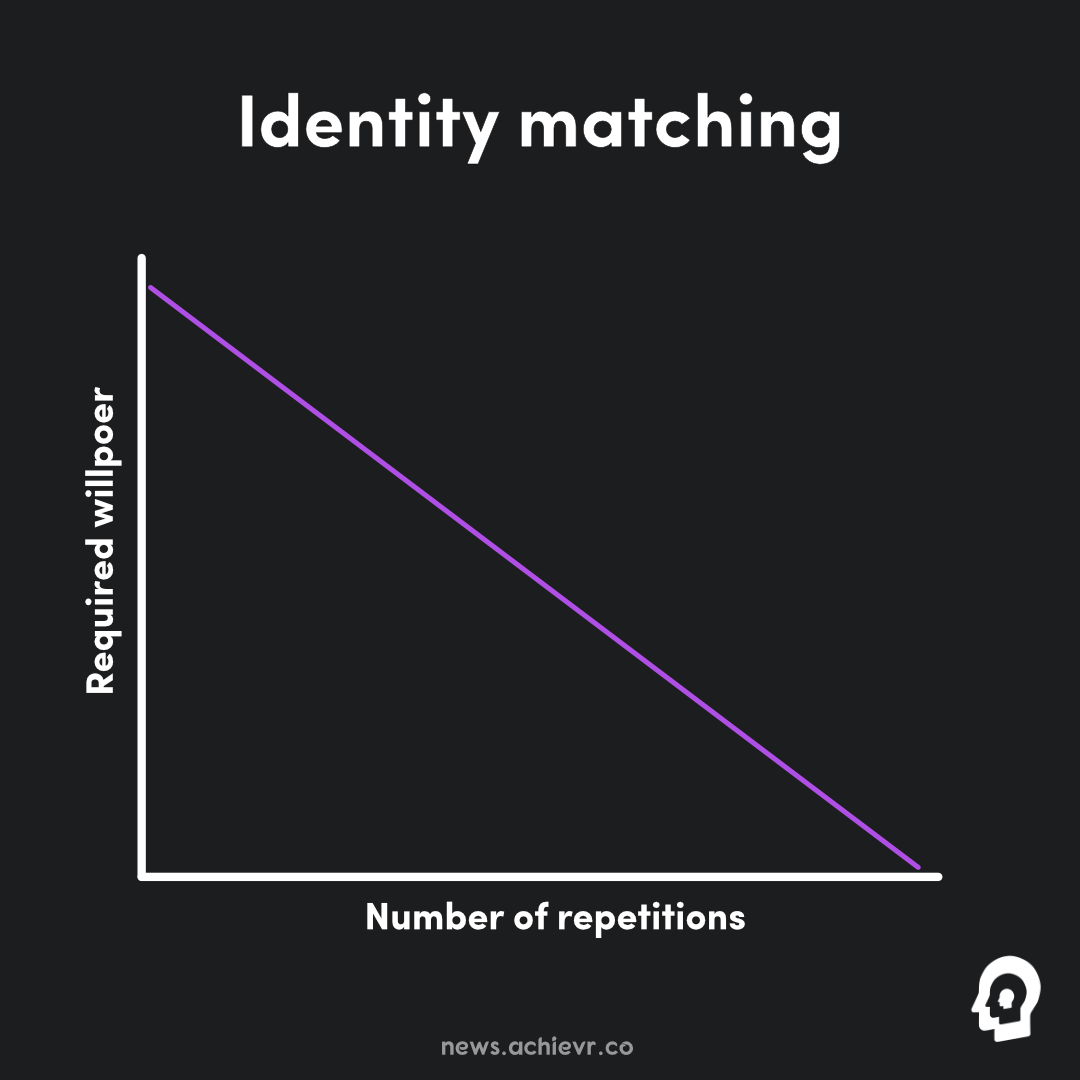
You can do it both ways:
Negative: cut reps of the actions that feed the identity you’re leaving. -
Positive: add reps of the actions that feed the identity you want. +
Consistency + number of reps = how easy it is to start a hard action.
You can divide it by role, and by negative and positive actions, and match them. The template to do that (Notion and print) is at the bottom of this post and in the resource library.
For example:
Employee (the current account, thousands of reps). Keep the 8 hours and do them well. Cut: work Slack after 18:00, “one small thing” for work at 20:30.
Builder (the new account, a few reps). Add: the project file open before the phone, one paragraph, one post out on Thursday. Cut: the video “for inspiration”, the third redesign of the Notion dashboard.
Which leaves a problem. You have to be the person before the evenings get easy. But the only way to become someone is to do what they do.
So which one goes first?
3. The first deposits have to fit the person you are now
“Men become builders by building and lyreplayers by playing the lyre; so too we become just by doing just acts, temperate by doing temperate acts, brave by doing brave acts.”
— Aristotle, Nicomachean Ethics II.1
Builders. I didn’t pick this one by accident.
Look at how FIRE deals with the same problem. You need investment income to retire, and you can’t have investment income without investing first.
People don’t wait for investment income before they start saving. People save out of the job they already have.
And they start with an amount they won’t miss. Nobody moves their whole salary into ETFs in month one.
Identity works the same way. You fund the builder out of the employee’s budget, in amounts so small the employee doesn’t notice they’re gone. The employee can’t veto 18 minutes. It can veto 3 hours every evening, and it will, around day 9.
James Clear wrote in Atomic Habits:
“Every action you take is a vote for the type of person you wish to become.”
Good start. But how do the votes get counted?
A new person has a value of 0 assigned to them. Every good action is +1, every bad one −1. I wrote about that in Tired is not a verdict. Here’s the part I didn’t say then.
When you get to know somebody, you count how often, and you barely look at how long. A coworker who brings you a coffee every morning for a month is “the nice guy”. The one who helped you move house once, for a whole Saturday, is “the guy who helped me move that one time”.
You judge yourself the same way. You work out who you are partly by watching what you do, like an outside observer would. The observer counts evenings. Hours barely register.
So a deposit has two rules.
It fits your worst evening. The one after a long, tough day when your head is empty. If the deposit only fits good evenings, every bad one becomes a gap, and you will have plenty of bad ones.
It leaves something behind that didn’t exist before. A paragraph. A fixed bug. A listing with a price. The whole rule is in Tired is not a verdict: one unit of work in one sitting.
The size will feel embarrassing. Good. The employee won’t bother fighting something that small.
My first month of working out was doing different variations of push-ups. My first month of AchievR (All Things Self Improvement then) was just putting fragments of my old mental health book somewhere on the internet.
You can start tonight with those rules. One deposit, something left behind.
I’ll be straight about how it goes, because it went this way for me.
Two things will break it.
The deposit will be the right size, and at 21:09 the sentence that ended your last projects shows up.
“I’ll catch up on Saturday.”
“I’m not ready.”
“It’s too hard for today”
“I’m not cut out to do those”
You’ll have nothing written to answer it, so it’ll win.
Then week 2. One bad evening, then a second one, then the old verdict comes back louder:
“See? I always quit.”
There’s no evidence yet to point at, so you’ll believe it.
That’s what The Builder Identity Install is for. 14 days, 18 minutes a night.
Days 1 to 7 find the sentence that repeats across your dead projects, and you write the answers to it while you’re still rested. Days 8 to 14 collect four nights of evidence, one of them on your worst evening on purpose, and tie the whole thing to one person, by name.
Autopsy. Rewrite. Evidence. Anchor. AREA!
$27. Do the 14 days, and if nothing moved I’ll refund you.
Paid subscribers have the rest of this deep dive below.
Founding Builders have the rest of this deep dive and the product. This one and every one after it.
One question is left, the paid half starts with it.
If every evening is a deposit, does it matter how big the deposit is?
4. Six small evenings beat one big Saturday
“If you wish to be a good reader, read; if you wish to be a good writer, write.”
— Epictetus, Discourses 2.18
In the same chapter, Epictetus tells his students how to stop being angry. Count the days you weren’t. “I used to be angry every day, after that every other day, then every third, and then every fourth day.”
He didn’t ask for zero. He counted how often. A habit tracker, nearly 2,000 years ago.
It’s easy to get the idea of FIRE. You can calculate how much you need in 5 minutes, set a goal, stick to it for decades and that’s the whole plan.
With identity, it’s abstract. Actions are not as easily comprehensible as numbers.
So let’s turn them into one.
Your identity has a savings rate. It’s the share of your evenings that vote for the builder.
