


At your day job, you finish things. Deadlines get met, tasks get closed, the week has a shape.
Then you sit down to your own project, the thing you actually care about, and somehow nothing moves.
You care more and do less. Makes no sense, right?
It does. Bear with me.
Walking in the fog
Point A is starting. Point B is seeing results.
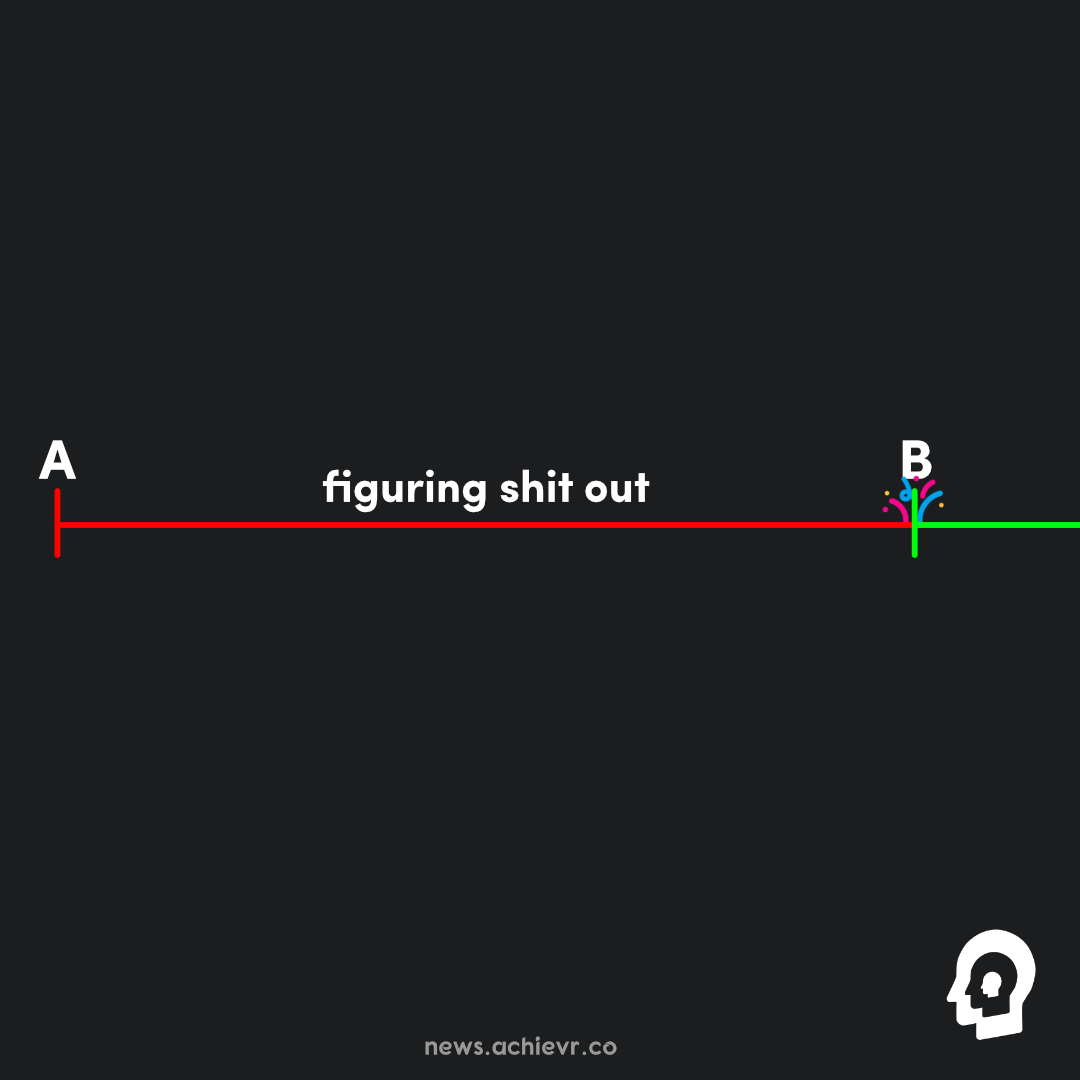
The time between is like walking in the fog.
You know the destination is there, somewhere, you may even be sure of it.
But not seeing 2 meters in front of you effectively raises doubts from time to time. Especially when other things in your life are not going well.
The crucial thing to do then is not to give up. As blatant as the advice is, it’s the best thing I can tell you.
I wrote about clearing the fog itself before: How Lack Of Clarity Stops You From Making Progress.
This post is about something I missed back then—where the fog comes from in the first place.
Most of it comes from one hole: no structure.
School gave you rails
This is one of the reasons why so many young adults feel lost after leaving school or finishing college.
School, even some shit-tier degree, gave you structure.
You knew what happens in a year, you knew what happens in a month, you knew where the endpoint is and when you’ll get there. From day one.
Fixed hours, deadlines set by someone else, someone else checking your work, a finish line with a date on it. You never had to decide if today counts because the system decided for you.
After graduation, the rails don't disappear. They get handed to your employer.
Nobody will kick you out
The job gives you the same deal: hours you show up for, deadlines with consequences, someone waiting for the result.
You may have noticed you are more productive at your day job than at your own thing, even though you care about your thing more.
Now count what your own project gives you. No hours. No deadline. Nobody waiting.
It’s the only part of your life nobody built rails for, and it’s the part you care about most. Nobody will kick you out of your own project.
That’s the good news and the whole problem.
Paradoxically, structure and outside pressure, the two things you resent at work, are what make goals easier to hit.
It’s easier to do a good workout at the public gym than in a home one, it’s easier to study in a library than at your kitchen table, it’s easier to clean the flat when someone’s coming over, easier to cook properly for a guest than for yourself.
Same you, same task. Rails change things.
Build your own rails
You can’t make your project fire you. Every other piece of the job’s structure, you can steal:
Fixed hours. Pick the time, pick the place, same every day. Early morning or late night work best. Your desk and you, nothing more.
A deadline someone knows about. Self-imposed deadlines are easy to move, your brain knows who set them. Give the date to another person: an accountability buddy. I wrote how to pick one in The Talker And Doer. A deadline only you know about is not a deadline.
Stakes. The job has consequences, your project needs some too. Book something that pays upfront. Pre-sell before it’s ready. Money on the table.
A visible endpoint. Define what done means for the next checkpoint only, two weeks out maximum, checkable. Not the whole staircase, the next stair. The rest stays in the fog and that’s fine. You only need to see the next 2 meters. Then the next 2.
New here? AchievR is one post a week for people with a real job and a project they refuse to give up on.
Identity, systems, consistency, output, money: things you can use the same night.
The welcome email comes with the Pathfinder Template: a free starting point for picking a project worth your hours.
How it looks in practice
This newsletter is the example.
It has working hours: 5-7 am currently (will write one about why too).
It has a public deadline, the weekly post, and it has someone waiting: you, reading this right now.
It has a checkpoint: one post. Never “build a newsletter,” always just the next Thursday.
Compare it to a project of mine that died. My music YouTube channel had none of that, and one day I just stopped uploading and never got back to it.
“I tried deadlines, I just ignore them”
Because they were yours alone, and quiet.
Deadlines fail when canceling them costs nothing.
Make canceling cost something: another person knowing, money already spent, a date said out loud in public. External pressure is cheaper than discipline.
And if even sitting down doesn’t happen, that’s a different problem, covered here: How To Do Hard Things Even When You Don’t Feel Like It.
Where it goes wrong
Copying the full school timetable. You have 2 hours, not 12. Structure the 2, leave the rest of your life alone. I genuinely think “just work 12 hours a day bro and you’ll make it” is bullshit, but that’s not for today.
Rails to nowhere. Fixed hours without a defined checkpoint is attendance theater. Busy, consistent, going nowhere. Endpoint first.
Stakes you can cancel quietly. If nobody would notice you dropping the deadline, you don’t have one.
Waiting for the fog to clear before you start. It clears by walking. Two meters is enough.
Try this now
Give your project working hours: same time, same place, starting today.
Any calendar app will do.
Define the next checkpoint: checkable, two weeks out, written down.
Sticky note in a visible place.
Add one external stake: tell one person the date, or pay for something upfront. Tonight, while it’s uncomfortable.
Tell the person you don’t want to make a bad impression on or pay for an annual subscription.
School handed you structure for free. The job still does.
Nobody will kick you out of your own project. Except you.
P. S. That’s basically why the systems pillar exists and what the products under this pillar will deliver. First comes the identity product, Q3 2026. Systems next. Until then, grab a premium sub.
Any suggestions?
Big shout-out to Jon, new premium subscriber of AchievR! You are allowing me to write these words. If you haven’t subscribed yet, join 4000+ hyper-achievers for free!
To read next:
